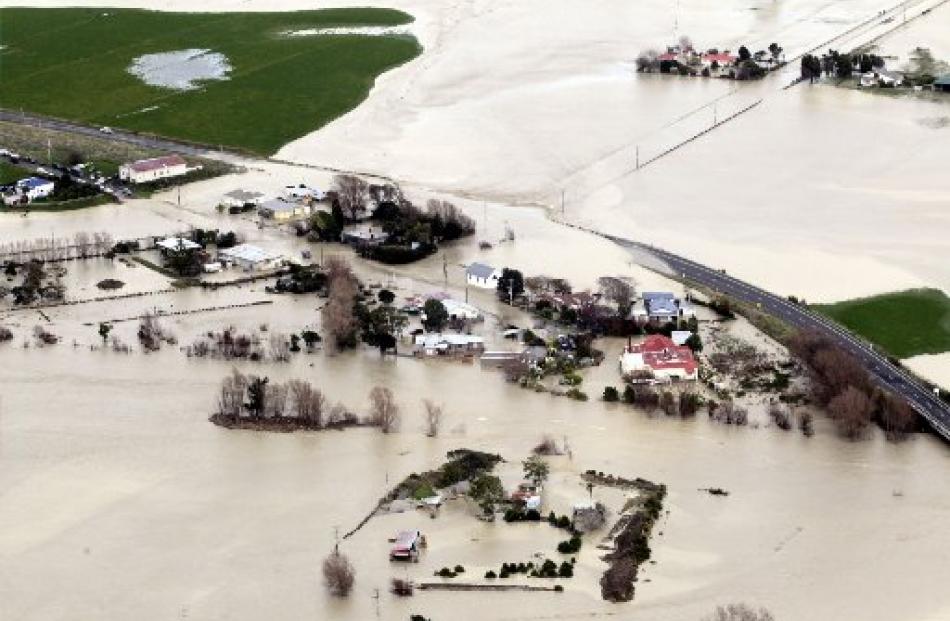
Further financial and other support for flood-stricken communities will be assessed as recoveries continue, Prime Minister John Key says.
A state of local emergency remains in place in Whanganui and Taranaki, Mr Key told reporters this afternoon. However, a state of local emergency in Rangitikei has been lifted.
"Cabinet today urgently considered the level of damage and need across the region, and in response Minister of Social Development Anne Tolley has triggered enhanced taskforce green, to provide urgent assistance," Mr Key said.
"So $250,000 will be released to support four teams of six people to work for 14 weeks on the clean-up ... [there will be] a further contribution of at least $250,000 towards disaster relief funds, in consultation with local mayors.
"We will continue to work with councils to assess the situation, thankfully the rain has stopped for now and rivers are receding."
Mr Key said the funding was focused on a short-term fix programme, but there would be bigger costs involved with fixing things like slips and roading damage.
"That's the reason why the Minister of Civil Defence [Nikki Kaye] is saying it's likely to run into the millions, and I think she is absolutely right."
Councils across the country would be looking at their infrastructure in light of recent extreme weather events. However, there were limits to what could be done to prepare for such events.
"In the end, you can only really expect councils to build the sort of infrastructure that can support ... something a little more than a normalised event, but not something on the outer edge.
"The trouble would be if councils were to build for those really extreme events, the issue just might be the sheer cost of that put on councils around the country."
Asked if he would link the flooding to climate change, he said it wasn't possible at this point to either confirm or deny a link.
"You have seen more volatile weather patterns recently ... certainly the advice we get from the scientific community is that ... the likelihood of climate change effects occurring is firming up.
"Government does look at those issues around mitigation ... and that is all part of the debate around coastal areas and whether there should be a national policy statement."
Insurance claims doubled over the weekend due to flooding in the regions, AA Insurance said.
Spokeswoman Amelia MacAndrew said the company was ready to help lower North Island customers with their flood-related claims, and urged those requiring emergency repairs to call as soon as possible.
Manawatu Gorge shut
Ongoing slips mean the Manawatu Gorge will remain closed until experts are convinced the risk to motorists is over.
Crews including abseilers were working to reopen highways and the New Zealand Transport Agency (NZTA) said getting traffic flowing through the Gorge was a major priority.
"The hillside has been completely saturated, with curtains of water streaming off it, and we need to wait for it to settle down and dry out before we can be confident the slope is safe and stable," NZTA regional performance manager Mark Owen said.
"We have specialist geotechnical engineers in to assess the slip sites, and they're in there right now, abseiling on the slip sites to get a closer look."
Mr Owen said NZTA was also determined to reopen State Highway 4 between Whanganui and Raetihi as soon as possible but that would take "a big effort" to remove a large number of slips.
"This has been the worst flood in memory for many people, and now that floodwaters are receding, our crews won't be letting up until the roads are open and back in good nick. In some areas this may take days, and in other areas it may take much longer, but we're here to get it done," he said.
"We thank local communities for hanging in there while our crews strive to get them connected as soon as we can."